 libterm.com
 Standardization establishes consistent quality and compatibility across products and services, fostering efficiency and innovation in various industries. It reduces costs by minimizing errors and simplifying processes, enhancing your experience as a consumer or business partner. Explore the rest of the article to discover how standardization impacts your daily life and global markets.
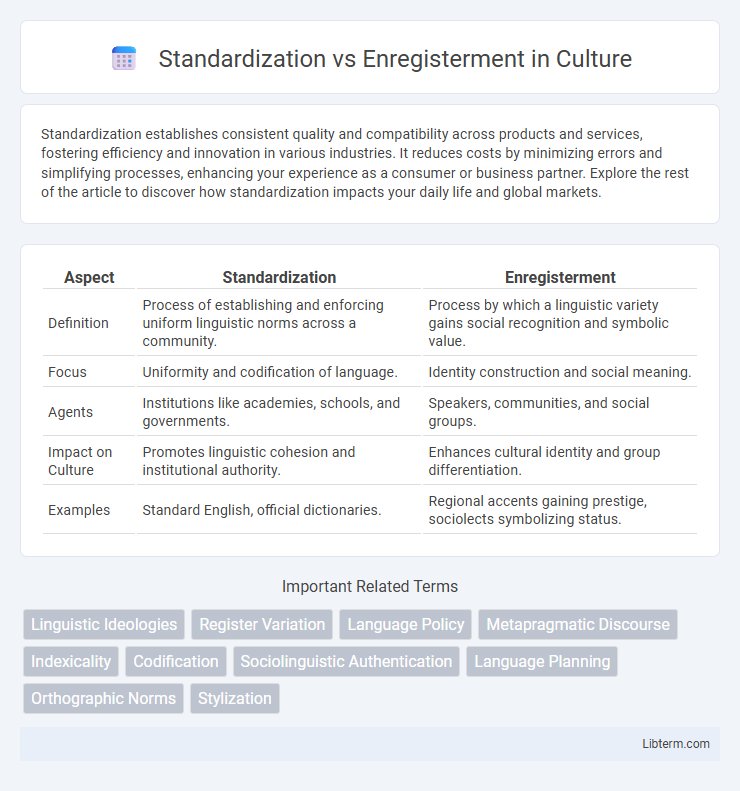
Table of Comparison
| Aspect | Standardization | Enregisterment |
|---|---|---|
| Definition | Process of establishing and enforcing uniform linguistic norms across a community. | Process by which a linguistic variety gains social recognition and symbolic value. |
| Focus | Uniformity and codification of language. | Identity construction and social meaning. |
| Agents | Institutions like academies, schools, and governments. | Speakers, communities, and social groups. |
| Impact on Culture | Promotes linguistic cohesion and institutional authority. | Enhances cultural identity and group differentiation. |
| Examples | Standard English, official dictionaries. | Regional accents gaining prestige, sociolects symbolizing status. |
Understanding Standardization and Enregisterment
Standardization refers to the process of developing and implementing technical standards to ensure consistency, compatibility, and quality across products, services, or systems. Enregisterment involves the social recognition and codification of a particular language variety as a distinct, prestigious norm within a community, often associated with identity and social status. Understanding these concepts highlights how standardization enforces uniformity in practical applications, while enregisterment emphasizes cultural and linguistic identity through established social norms.
Historical Development of Language Standards
Standardization and enregisterment in language involve distinct historical developments, with standardization focusing on codifying linguistic norms through dictionaries, grammar books, and institutional endorsement since the 18th century. Enregisterment, on the other hand, emerges from social recognition and valorization of language varieties, gaining prominence in sociolinguistics during the late 20th century as communities link language features to identity and social meaning. The historical trajectory of language standards reveals how formal regulation and social practices jointly shape language ideologies and linguistic hierarchies over time.
Processes Involved in Standardization
Standardization involves codifying language norms through processes such as selection, codification, implementation, and acceptance, ensuring consistent usage across a speech community. These steps include choosing a prestige dialect, developing comprehensive grammar and dictionaries, promoting the standardized form in education and media, and achieving widespread public endorsement. This systematic approach contrasts with enregisterment, which focuses more on the social recognition and indexing of language varieties rather than formal systematization.
Key Features of Enregisterment
Enregisterment involves the social recognition and association of specific linguistic features with particular social identities or communities, emphasizing how language varieties become emblematic of group membership. Key features include indexicality, where linguistic traits point to social meanings, and sedimentation, where repeated use solidifies these associations over time. Unlike standardization, which codifies language norms for broad, institutional use, enregisterment highlights the dynamic, identity-driven processes linking language to social and cultural practices.
Sociolinguistic Implications of Standardization
Standardization significantly influences social identity by establishing a uniform linguistic norm that can elevate prestige and facilitate communication across diverse groups, yet it may marginalize regional dialects and minority languages. Enregisterment, on the other hand, involves the recognition and valorization of specific language varieties or features as indexes of social identity within particular communities. The sociolinguistic implications of standardization include potential language shift, loss of linguistic diversity, and reinforcement of power dynamics through the promotion of a dominant language form.
Enregisterment and Identity Construction
Enregisterment plays a crucial role in identity construction by linking linguistic features to social meanings and group membership, reinforcing communal bonds through shared language practices. Unlike standardization, which imposes uniformity for broader communication, enregisterment highlights distinct speech styles that symbolize cultural heritage and collective identity. This process transforms everyday language use into symbols of social identity, emphasizing variation as a marker of belonging rather than deviation.
Comparing Standardized Varieties and Registers
Standardized varieties are codified language forms regulated by official institutions, serving as benchmarks for education, media, and formal communication, while registers refer to situational language variations adjusted according to context, audience, and purpose. Standardization involves establishing fixed grammar, vocabulary, and orthography norms, promoting uniformity and mutual intelligibility across regions and social groups. Registers, encompassing formal, informal, technical, and colloquial modes, enable speakers to navigate social interactions by dynamically adapting language use without altering core linguistic structures.
The Role of Institutions in Language Standardization
Institutions such as language academies, educational systems, and governmental bodies play a crucial role in language standardization by codifying norms, producing authoritative dictionaries, and setting grammatical rules. These entities influence enregisterment by promoting specific language varieties as prestigious or official, thereby shaping social identity and linguistic behavior. The interplay between institutional policies and community practices determines the extent to which a language form becomes widely accepted and socially recognized.
Case Studies: Standardization vs. Enregisterment in Practice
Case studies in sociolinguistics highlight how standardization often aims to create uniform language norms, while enregisterment emphasizes the social recognition of language varieties as identity markers. For example, the standardization of French through the Academie Francaise contrasts with the enregisterment of African American Vernacular English, which signifies cultural identity beyond formal rules. These practical instances demonstrate how language policies and social dynamics shape linguistic prestige and community belonging differently.
Future Directions in Language Standardization and Enregisterment
Future directions in language standardization emphasize the integration of digital technologies and AI to create more inclusive, dynamic standards that reflect evolving linguistic practices. Enregisterment research is increasingly focusing on how social media and globalization influence the emergence and recognition of new linguistic registers associated with identity and community. Both fields converge on the potential for adaptive frameworks that balance prescriptive norms with descriptive realities, fostering language diversity and sociolinguistic awareness.
Standardization Infographic