 libterm.com
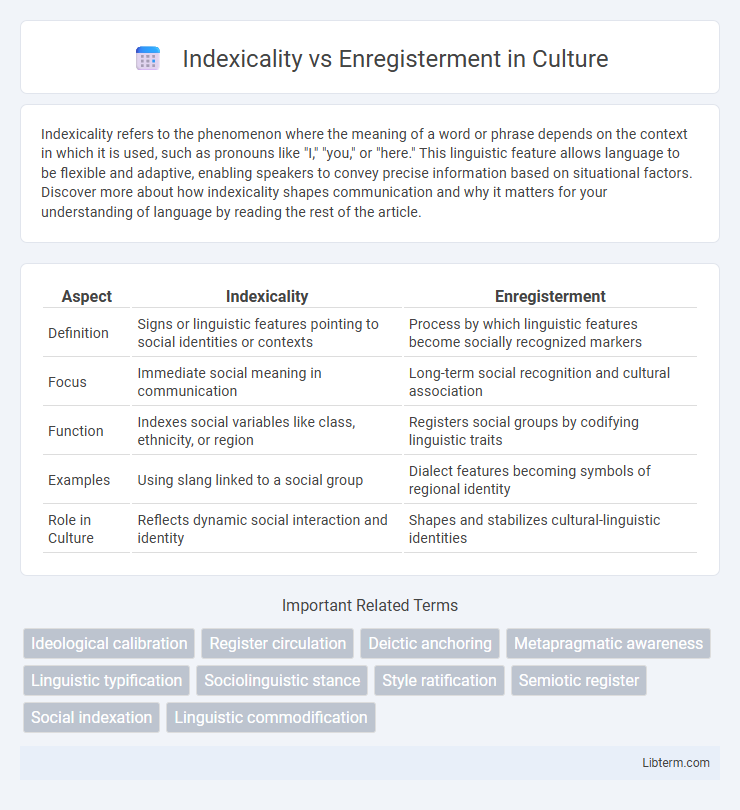
 Indexicality refers to the phenomenon where the meaning of a word or phrase depends on the context in which it is used, such as pronouns like "I," "you," or "here." This linguistic feature allows language to be flexible and adaptive, enabling speakers to convey precise information based on situational factors. Discover more about how indexicality shapes communication and why it matters for your understanding of language by reading the rest of the article.
Table of Comparison
| Aspect | Indexicality | Enregisterment |
|---|---|---|
| Definition | Signs or linguistic features pointing to social identities or contexts | Process by which linguistic features become socially recognized markers |
| Focus | Immediate social meaning in communication | Long-term social recognition and cultural association |
| Function | Indexes social variables like class, ethnicity, or region | Registers social groups by codifying linguistic traits |
| Examples | Using slang linked to a social group | Dialect features becoming symbols of regional identity |
| Role in Culture | Reflects dynamic social interaction and identity | Shapes and stabilizes cultural-linguistic identities |
Understanding Indexicality: Core Concepts
Indexicality refers to the linguistic phenomenon where words or expressions derive meaning from contextual cues, such as speaker identity, time, and place, making interpretation dependent on situational factors. Core concepts in understanding indexicality include deictic expressions like pronouns and demonstratives, which point to specific elements within a speech context. This dynamic relationship between language and social context highlights how meaning is not fixed but fluid, shaped by both linguistic forms and the immediate environment.
The Evolution of Enregisterment in Linguistics
Enregisterment in linguistics refers to the process by which specific linguistic features become socially recognized as part of a distinct register or style, evolving through repeated social interactions and indexing particular identities or social meanings. Unlike indexicality, which hinges on the immediate contextual association of language features with social meanings, enregisterment involves a stabilized and widely acknowledged repertoire of linguistic forms linked to specific social groups or contexts. Over time, enregisterment solidifies language varieties into recognizable social categories, facilitating identity construction and social differentiation in linguistic communities.
Comparing Indexicality and Enregisterment: Key Differences
Indexicality refers to the way linguistic elements point to social meanings or contexts through use, grounding language in specific social identities and interactions. Enregisterment, by contrast, involves the process through which particular language forms become socially recognized and associated with distinct social groups or practices over time. While indexicality emphasizes moment-to-moment contextual meaning in communication, enregisterment highlights the stabilization and social recognition of these linguistic features as markers of identity.
Historical Background of Indexicality
Indexicality originates from the study of linguistic signs where indexical signs directly point to contextual features, rooted in Charles Sanders Peirce's semiotic theory from the late 19th century. Early linguistic research emphasized how indexicality captures real-time speaker intentions and social context through deixis, pronouns, and tense markers. The historical foundation highlights how indexicality evolved as a key concept linking language with situational context, influencing sociolinguistic theories that explore language's role in identity and social interaction.
The Process of Enregisterment Explained
Enregisterment refers to the process by which specific linguistic features become recognized as socially meaningful signs associated with a particular group or identity, transforming indexicality from mere contextual reference to a stable social marker. This process involves repeated social recognition, differentiation from other ways of speaking, and symbolic value assignment that establishes a connection between language forms and social identities. Enregistered features gain salience and are often codified in norms, stereotypes, or metapragmatic commentary, reinforcing group boundaries through language use.
Social Meaning in Indexicality and Enregisterment
Indexicality reveals social meaning by linking linguistic features to specific communities or identities, showcasing how language variables signal social categories like class, ethnicity, or gender in real-time interaction. Enregisterment involves the conventionalization of these social meanings into recognizable linguistic registers or styles that speakers consciously or unconsciously adopt to enact social identities or group membership. Together, indexicality and enregisterment explain how language variation not only reflects but also constructs social meaning through patterns of use tied to broader socio-cultural norms.
Indexical Order and Language Variation
Indexicality involves how linguistic signs point to social meanings through indexical orders, where higher-order indexes connect language features to broader social identities and practices. Language variation manifests as speakers navigate multiple indexical orders, selecting variants that signal group membership, stance, or social positioning. Enregisterment emerges when repeated recognition of these patterns crystallizes certain linguistic features into socially meaningful registers linked to specific communities or identities.
Case Studies: Indexicality vs Enregisterment in Practice
Case studies on indexicality versus enregisterment reveal how linguistic features transition from context-dependent meanings to socially recognized registers. For example, African American Vernacular English (AAVE) demonstrates indexicality by signaling in-group identity and, through enregisterment, becomes a recognized cultural marker with distinctive syntactic and phonological traits. Research on regional dialects like Appalachian English shows how specific linguistic forms initially index local identity but undergo enregisterment as they become emblematic of regional pride and heritage.
Implications for Sociolinguistic Research
Indexicality reveals how linguistic features point to social meanings and identities in context, highlighting variability and speaker agency in language use. Enregisterment examines how certain language varieties become recognized as social registers, codifying and stabilizing social meanings across communities. Understanding the dynamic interplay of indexicality and enregisterment enables sociolinguistic research to better analyze language variation, identity construction, and the processes of social stratification.
Future Directions in the Study of Indexicality and Enregisterment
Future directions in the study of indexicality and enregisterment emphasize the integration of digital communication platforms to analyze how linguistic features evolve and gain social meaning in online communities. Researchers plan to utilize advanced computational methods and big data analytics to map the dynamic processes of enregisterment across diverse sociolinguistic landscapes. Emerging studies also focus on the intersection of multimodality and indexicality, exploring how visual and auditory cues contribute to linguistic indexing and identity construction in contemporary discourse.
Indexicality Infographic