 libterm.com
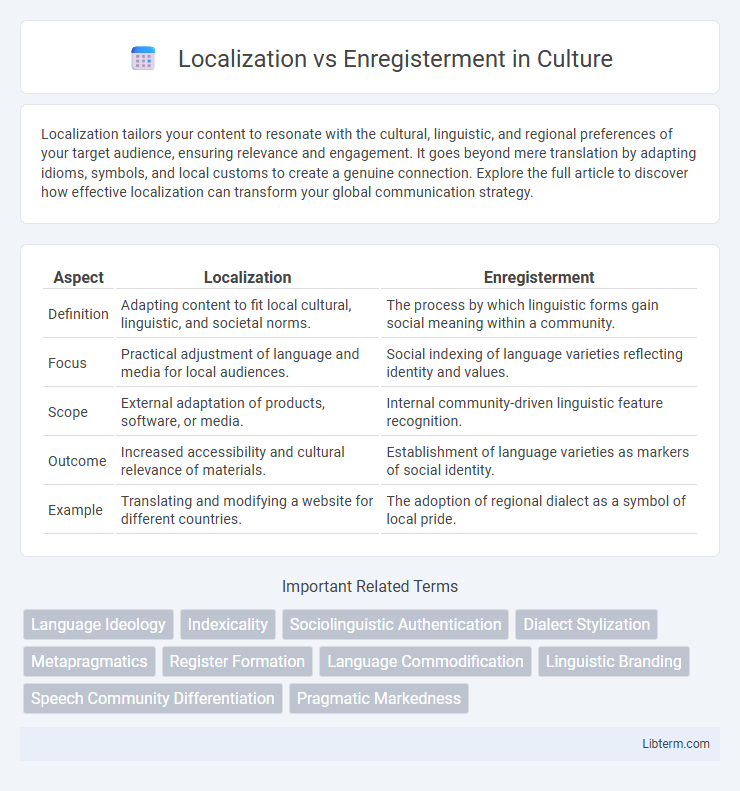
 Localization tailors your content to resonate with the cultural, linguistic, and regional preferences of your target audience, ensuring relevance and engagement. It goes beyond mere translation by adapting idioms, symbols, and local customs to create a genuine connection. Explore the full article to discover how effective localization can transform your global communication strategy.
Table of Comparison
| Aspect | Localization | Enregisterment |
|---|---|---|
| Definition | Adapting content to fit local cultural, linguistic, and societal norms. | The process by which linguistic forms gain social meaning within a community. |
| Focus | Practical adjustment of language and media for local audiences. | Social indexing of language varieties reflecting identity and values. |
| Scope | External adaptation of products, software, or media. | Internal community-driven linguistic feature recognition. |
| Outcome | Increased accessibility and cultural relevance of materials. | Establishment of language varieties as markers of social identity. |
| Example | Translating and modifying a website for different countries. | The adoption of regional dialect as a symbol of local pride. |
Introduction to Localization and Enregisterment
Localization adapts content to meet the linguistic, cultural, and functional needs of a specific target market or audience, ensuring relevance and usability across different regions. Enregisterment refers to the process by which linguistic features become socially recognized and associated with particular social identities or groups. Understanding the distinction between localization's focus on adapting materials and enregisterment's emphasis on social identity helps optimize communication strategies for diverse audiences.
Defining Localization in Language
Localization in language involves adapting content to meet the linguistic, cultural, and contextual nuances of a specific target audience, ensuring that idiomatic expressions, slang, and regional dialects resonate authentically. Enregisterment refers to the process by which these localized language features become recognized and associated with a particular social group or identity, transforming into a distinct register. Understanding localization emphasizes the importance of precise, culturally relevant adaptation beyond mere translation to achieve effective communication.
Understanding Enregisterment: A Sociolinguistic Perspective
Enregisterment refers to the social process by which certain speech forms become recognized as distinct registers linked to specific identities or social groups, shaping language use in everyday interactions. This concept highlights how linguistic features are socially valued and associated with particular communities, influencing perceptions of authenticity and social status. Understanding enregisterment provides insight into how language variation is not only about communication but also about expressing and negotiating cultural and social identities.
Key Differences Between Localization and Enregisterment
Localization involves adapting content or products to meet the linguistic, cultural, and functional requirements of a specific target market, emphasizing practical customization for usability. Enregisterment refers to the process by which linguistic features become recognized as markers of social identity or group membership within a community. The key difference lies in localization targeting external adaptation for market relevance, while enregisterment focuses on internal sociolinguistic development and identity indexing.
The Role of Context in Localization and Enregisterment
Localization adapts content to the linguistic, cultural, and social context of a target audience, ensuring relevance and usability across regions. Enregisterment involves the process by which specific language varieties become recognized as distinct social registers tied to particular identities or communities. The role of context is pivotal in both, as localization requires understanding situational needs and cultural nuances, while enregisterment depends on repeated social practices that index and reinforce language variation within specific contexts.
Cultural Influence on Language Variation
Localization adapts language and content to reflect specific cultural contexts, ensuring relevance and resonance with target audiences through tailored idioms, customs, and social norms. Enregisterment involves the process by which certain linguistic features become recognized as markers of a particular social or regional identity, solidifying their usage within cultural groups. Both phenomena demonstrate the profound influence of culture on language variation, shaping not only vocabulary and syntax but also sociolinguistic identity and communicative practices.
Impact of Localization in Global Communication
Localization enhances global communication by adapting content to meet cultural, linguistic, and regional preferences, ensuring messages resonate effectively with diverse audiences. This process improves user engagement, reduces misunderstandings, and fosters trust across international markets. By prioritizing localized content, businesses can expand their global reach and create meaningful connections that respect local norms and values.
Enregisterment and Social Identity
Enregisterment refers to the process by which particular linguistic features become socially recognized as markers of group identity, embedding language use within cultural and social frameworks. This phenomenon plays a crucial role in shaping social identity by linking specific speech patterns, accents, or dialects to community membership, status, or ethnicity. Unlike localization, which adapts language to regional contexts, enregisterment actively constructs and reinforces social meanings and identities through language.
Case Studies: Examples of Localization and Enregisterment
Case studies on localization often highlight how global brands adapt products and marketing strategies to fit the linguistic, cultural, and social norms of target markets, such as McDonald's adjusting menus and advertising in India to respect local dietary preferences. In contrast, enregisterment case studies focus on the social processes by which particular language varieties become recognized and associated with specific social identities, exemplified by the rise of Singlish in Singapore as a marker of national identity and social solidarity. These examples underscore localization's emphasis on market adaptation, while enregisterment reveals how language varieties gain social meaning and legitimacy within communities.
Future Trends in Language Adaptation and Standardization
Future trends in language adaptation emphasize the growing importance of localization techniques that address cultural nuances and regional dialects to improve user experience and engagement. Enregisterment processes are expected to accelerate as digital communication fosters the emergence of new standardized language varieties and sociolects aligned with global and local identities. Advances in AI and machine translation technology will play a critical role in refining both localization and enregisterment by enabling more context-aware and dynamic language standardization solutions.
Localization Infographic