 libterm.com
 Exhibition design transforms spaces into immersive environments that effectively communicate a brand's message and engage visitors through creative layouts, lighting, and interactive elements. Strategic use of colors, materials, and technology enhances the storytelling experience, making the exhibition memorable and impactful. Discover how expert exhibition design can elevate your next event by reading the rest of this article.
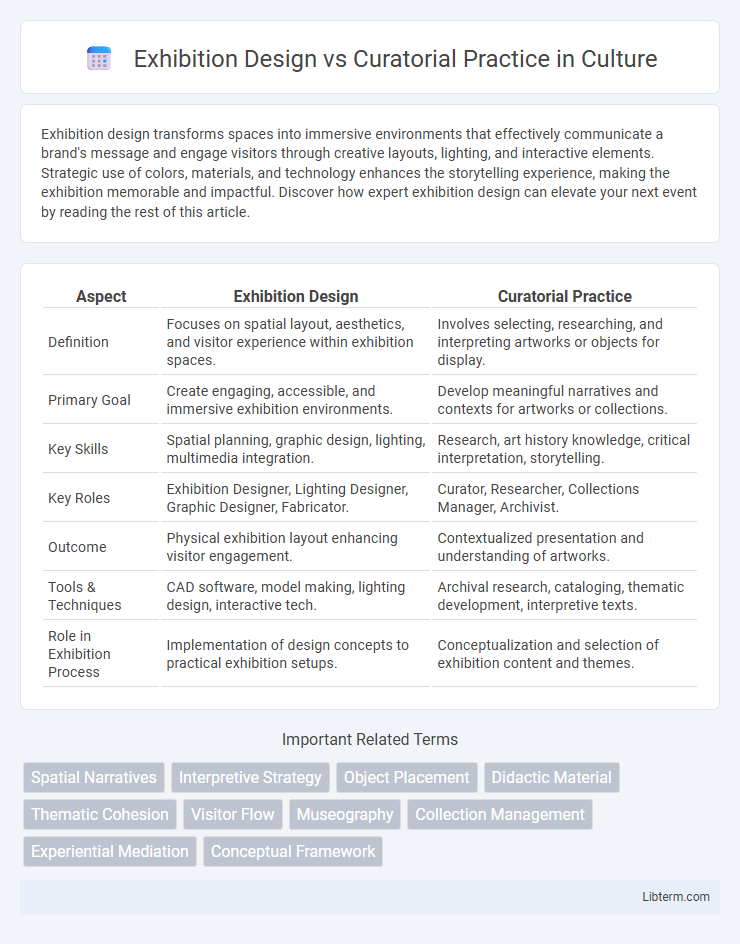
Table of Comparison
| Aspect | Exhibition Design | Curatorial Practice |
|---|---|---|
| Definition | Focuses on spatial layout, aesthetics, and visitor experience within exhibition spaces. | Involves selecting, researching, and interpreting artworks or objects for display. |
| Primary Goal | Create engaging, accessible, and immersive exhibition environments. | Develop meaningful narratives and contexts for artworks or collections. |
| Key Skills | Spatial planning, graphic design, lighting, multimedia integration. | Research, art history knowledge, critical interpretation, storytelling. |
| Key Roles | Exhibition Designer, Lighting Designer, Graphic Designer, Fabricator. | Curator, Researcher, Collections Manager, Archivist. |
| Outcome | Physical exhibition layout enhancing visitor engagement. | Contextualized presentation and understanding of artworks. |
| Tools & Techniques | CAD software, model making, lighting design, interactive tech. | Archival research, cataloging, thematic development, interpretive texts. |
| Role in Exhibition Process | Implementation of design concepts to practical exhibition setups. | Conceptualization and selection of exhibition content and themes. |
Introduction: Defining Exhibition Design and Curatorial Practice
Exhibition design involves the strategic planning and spatial organization of artworks and artifacts to create an immersive visitor experience, emphasizing visual communication and environmental interaction. Curatorial practice focuses on the research, selection, interpretation, and contextualization of exhibition content, shaping narratives that engage diverse audiences. Both disciplines collaborate to balance aesthetic presentation with meaningful storytelling in museum and gallery settings.
Historical Evolution of Exhibitions and Curatorship
Exhibition design and curatorial practice have evolved significantly since the 19th century, shaped by museums' increasing focus on visitor engagement and educational storytelling. Early exhibitions prioritized object display and classification, while contemporary practices emphasize narrative construction and immersive experiences through interdisciplinary collaboration. The historical evolution reflects a shift from merely presenting artifacts to creating dynamic dialogues between objects, audiences, and contexts, fundamentally transforming curatorship into a strategic, interpretive process.
Key Roles and Responsibilities of Exhibition Designers
Exhibition designers are responsible for creating cohesive visual environments that effectively communicate the curatorial narrative and engage diverse audiences. Their key roles include spatial planning, selecting materials, lighting design, and integrating multimedia elements to enhance the visitor experience. Collaboration with curators ensures that the conceptual vision aligns with practical execution, balancing aesthetics with functionality and accessibility.
Core Functions of Curators in Art and Museums
Curators in art and museums primarily focus on the selection, research, and interpretation of artworks to create meaningful narratives within exhibitions. Their core functions include acquiring and preserving collections, developing thematic coherence, and providing educational context to engage diverse audiences. Exhibition design complements curatorial practice by translating these narratives into spatial and visual experiences that enhance visitor interaction and understanding.
Design Process vs. Curatorial Strategy
Exhibition design centers on spatial planning, visual hierarchy, and audience interaction to create an immersive environment that enhances the presentation of artworks. Curatorial practice involves strategizing thematic narratives, selecting pieces that align with conceptual goals, and fostering critical engagement through interpretive frameworks. The design process translates curatorial strategy into tangible layouts, balancing aesthetics and functionality to effectively communicate the exhibition's message.
Collaboration and Interdisciplinary Approaches
Exhibition design and curatorial practice intersect through collaborative processes that integrate diverse expertise from artists, designers, historians, and technologists to create immersive and meaningful experiences. Interdisciplinary approaches enhance narrative depth and spatial innovation, blending visual aesthetics with scholarly research and audience engagement strategies. This synergy fosters dynamic exhibitions that evolve beyond traditional displays, emphasizing adaptability and multi-sensory interaction.
Impact on Visitor Experience and Engagement
Exhibition design shapes the physical and visual environment, using spatial layout, lighting, and multimedia to enhance visitor immersion and guide emotional responses. Curatorial practice influences content selection, narrative flow, and thematic coherence, fostering intellectual engagement and deeper understanding. Together, these disciplines create a dynamic visitor experience that balances sensory stimulation with meaningful interpretation.
Technology Integration in Exhibition and Curation
Exhibition design leverages advanced technologies such as augmented reality (AR), virtual reality (VR), and interactive digital displays to enhance visitor engagement and spatial storytelling. Curatorial practice integrates data analytics, digital archives, and AI-driven content curation tools to refine exhibit narratives and personalize audience experiences. Both fields increasingly utilize immersive media and smart technologies to create dynamic, impactful exhibitions that bridge physical and virtual realms.
Challenges and Opportunities in Each Field
Exhibition design faces challenges such as spatial constraints, audience engagement, and integrating multimedia elements, while offering opportunities to create immersive, interactive environments that enhance visitor experience. Curatorial practice contends with balancing artistic vision, cultural representation, and ethical considerations, presenting opportunities to shape meaningful narratives and foster critical dialogue. Both fields demand collaboration and adaptability to evolving technologies and diverse audience expectations, driving innovation in how art and information are presented.
Future Trends: Blurring Boundaries Between Design and Curatorship
The future of exhibition design and curatorial practice reveals a growing convergence where designers and curators collaboratively co-create immersive, multisensory experiences that transcend traditional roles. Emerging technologies such as augmented reality (AR) and artificial intelligence (AI) enable dynamic storytelling, fostering deeper audience engagement and personalized interactions within gallery spaces. This blurring of boundaries prioritizes interdisciplinary expertise, redefining narrative construction and spatial aesthetics to reflect evolving cultural contexts and digital innovation.
Exhibition Design Infographic