 libterm.com
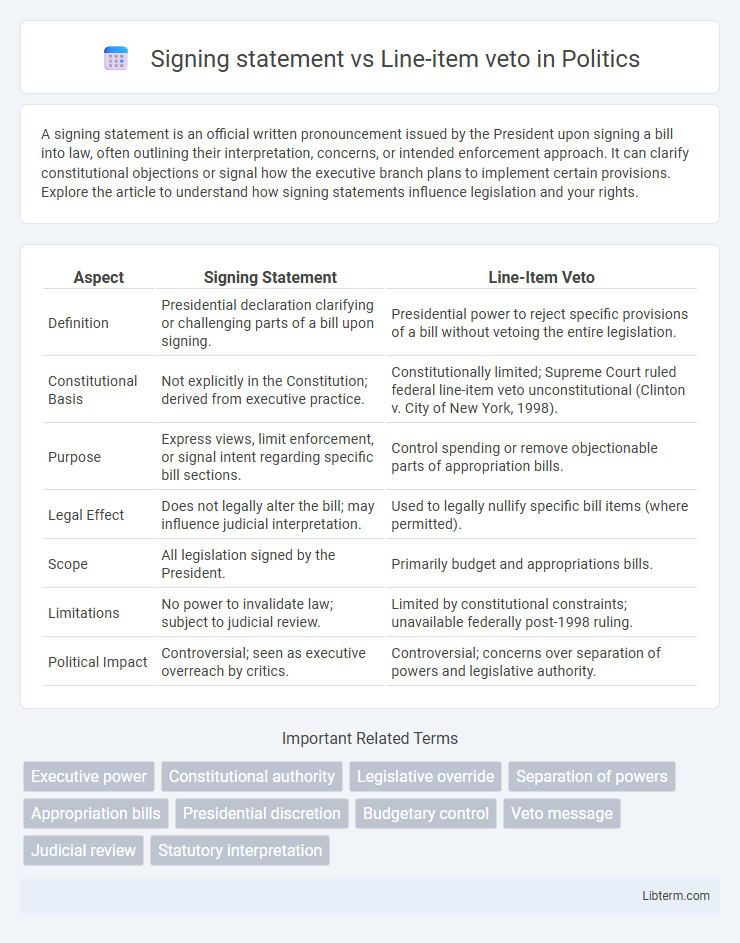
 A signing statement is an official written pronouncement issued by the President upon signing a bill into law, often outlining their interpretation, concerns, or intended enforcement approach. It can clarify constitutional objections or signal how the executive branch plans to implement certain provisions. Explore the article to understand how signing statements influence legislation and your rights.
Table of Comparison
| Aspect | Signing Statement | Line-Item Veto |
|---|---|---|
| Definition | Presidential declaration clarifying or challenging parts of a bill upon signing. | Presidential power to reject specific provisions of a bill without vetoing the entire legislation. |
| Constitutional Basis | Not explicitly in the Constitution; derived from executive practice. | Constitutionally limited; Supreme Court ruled federal line-item veto unconstitutional (Clinton v. City of New York, 1998). |
| Purpose | Express views, limit enforcement, or signal intent regarding specific bill sections. | Control spending or remove objectionable parts of appropriation bills. |
| Legal Effect | Does not legally alter the bill; may influence judicial interpretation. | Used to legally nullify specific bill items (where permitted). |
| Scope | All legislation signed by the President. | Primarily budget and appropriations bills. |
| Limitations | No power to invalidate law; subject to judicial review. | Limited by constitutional constraints; unavailable federally post-1998 ruling. |
| Political Impact | Controversial; seen as executive overreach by critics. | Controversial; concerns over separation of powers and legislative authority. |
Introduction: Understanding Executive Powers
The signing statement allows a president to express interpretations or objections to specific provisions of a bill while approving it, shaping its enforcement without blocking the entire law. In contrast, the line-item veto grants the president the power to reject particular budget items or spending provisions within a bill without vetoing the entire legislation, directly influencing government expenditures. Both tools highlight the complex executive powers that balance legislative intent and presidential authority in the U.S. government.
Defining Signing Statements
Signing statements are written pronouncements issued by the President upon signing a bill into law, often clarifying the administration's interpretation or expressing concerns about specific provisions. Unlike the line-item veto, which allows a President to reject particular parts of legislation, signing statements do not alter the legal effect of the bill but may signal intent on enforcement or constitutional issues. Courts have generally upheld the constitutional limits on signing statements, emphasizing their role as interpretive tools rather than legislative vetoes.
Defining the Line-item Veto
The line-item veto is a legislative power allowing executives, such as a president or governor, to reject specific provisions or items in a bill without vetoing the entire legislation. This authority enables targeted removal of particular budget items or expenditures while preserving the rest of the bill. In contrast, a signing statement is a written comment issued by the executive upon signing a bill, often interpreting or expressing concerns about specific provisions, but lacking the power to alter or veto parts of the law.
Constitutional Foundations and Legal Authority
Signing statements arise from the President's constitutional role to execute laws, serving as official interpretations or objections without nullifying legislation, grounded in Article II's Take Care Clause. The line-item veto, by contrast, involves the executive's power to reject specific provisions of a bill, which courts have deemed unconstitutional based on the Presentment Clause in Article I, as it effectively allows the President to amend laws without congressional approval. The Supreme Court invalidated the line-item veto in Clinton v. City of New York (1998), affirming the separation of powers and emphasizing that such authority must originate from Congress, highlighting the distinct legal foundations differentiating signing statements and the line-item veto.
Historical Use by U.S. Presidents
U.S. presidents historically used signing statements primarily to express constitutional concerns or interpret legislative intent during bill enactment, with notable examples from presidents like George W. Bush and Ronald Reagan influencing executive-legislative relations. In contrast, the line-item veto, first granted by the Line Item Veto Act of 1996 and declared unconstitutional by the Supreme Court in 1998, was briefly used by President Bill Clinton but never became a sustained presidential tool. The historical use of signing statements reflects ongoing presidential attempts to shape legislation post-enactment, whereas the line-item veto represented a limited, judicially restricted effort to control federal spending more directly.
Key Differences: Signing Statement vs. Line-item Veto
Signing statements are official presidential comments attached to a bill, used to express interpretation or constitutional concerns, without changing the bill's text. The line-item veto allows a president to selectively veto specific provisions of a spending bill, effectively removing parts without rejecting the entire legislation, though it has faced constitutional challenges and is not currently permitted. Key differences lie in legal power and usage: signing statements interpret or challenge legislation post-passage, while the line-item veto directly alters enacted bills before they become law.
Impact on Legislative Process
Signing statements allow presidents to express interpretations or objections to specific provisions without blocking the law, often influencing how statutes are enforced and shaping judicial review. The line-item veto empowers executives to reject particular budget items or expenditures, streamlining spending but potentially altering legislative compromise and balance. Both tools affect legislative strategy, with signing statements preserving enacted laws while modifying application and line-item vetoes directly reducing legislative appropriations.
Major Controversies and Legal Challenges
Signing statements have sparked major controversies due to their perceived potential to bypass Congressional intent, with critics arguing they allow Presidents to reinterpret or refuse to enforce specific provisions of laws. The line-item veto has faced significant legal challenges, most notably in the 1998 Supreme Court case Clinton v. City of New York, where the Court ruled it unconstitutional, stating it violated the Presentment Clause by enabling the President to unilaterally amend or repeal parts of legislation. Both tools raise profound questions about the separation of powers, with debates centered on executive overreach and the constitutional limits of presidential authority in shaping legislation.
Case Studies: Notable Examples in U.S. History
Signing statements have been notably used by Presidents Reagan and Bush to express constitutional concerns or interpretative views on legislation, influencing judicial review without nullifying specific provisions. The line-item veto, examined critically in the 1996 case Clinton v. City of New York, was struck down by the Supreme Court as unconstitutional, reinforcing the separation of powers by preventing presidents from unilaterally removing parts of statutes. These case studies illustrate the ongoing tension between executive authority and legislative intent in U.S. constitutional law.
Conclusion: Implications for Separation of Powers
Signing statements and line-item vetoes present distinct implications for the separation of powers, with signing statements allowing presidents to interpret or challenge legislative provisions without outright rejecting bills. The line-item veto, by contrast, empowers executives to selectively nullify specific spending items, raising concerns over encroachment on congressional budgetary authority. Both tools test the balance of checks and balances, potentially expanding executive influence at the expense of legislative supremacy.
Signing statement Infographic