 libterm.com
 Mechanism design is a field in economics and game theory that focuses on creating systems or protocols to achieve desired outcomes despite individuals acting in their own self-interest. It involves designing rules and incentives that align individual behavior with overall social or organizational goals. Explore the full article to understand how mechanism design can optimize your strategic decision-making.
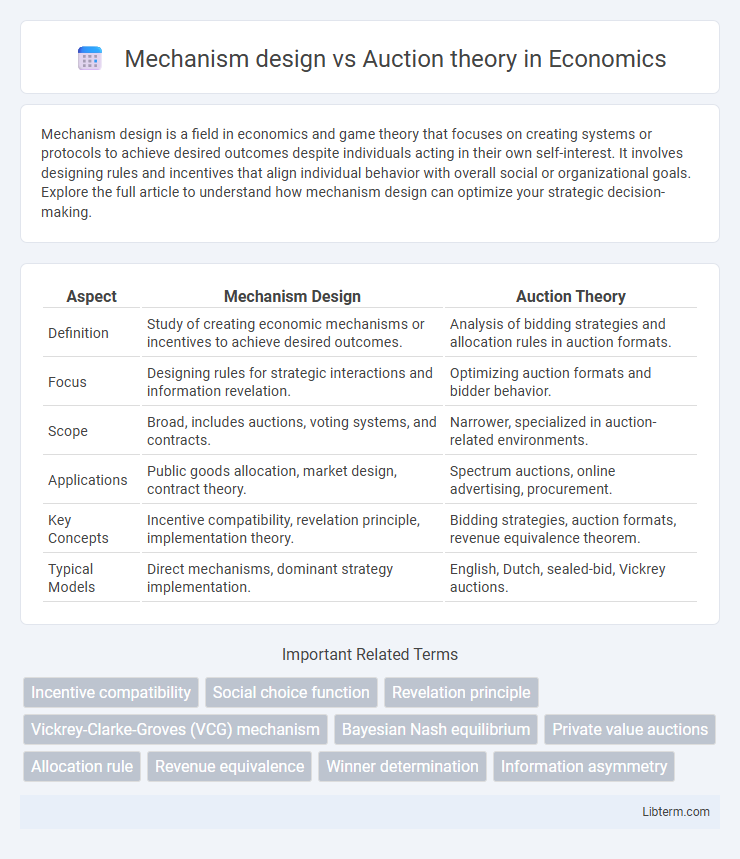
Table of Comparison
| Aspect | Mechanism Design | Auction Theory |
|---|---|---|
| Definition | Study of creating economic mechanisms or incentives to achieve desired outcomes. | Analysis of bidding strategies and allocation rules in auction formats. |
| Focus | Designing rules for strategic interactions and information revelation. | Optimizing auction formats and bidder behavior. |
| Scope | Broad, includes auctions, voting systems, and contracts. | Narrower, specialized in auction-related environments. |
| Applications | Public goods allocation, market design, contract theory. | Spectrum auctions, online advertising, procurement. |
| Key Concepts | Incentive compatibility, revelation principle, implementation theory. | Bidding strategies, auction formats, revenue equivalence theorem. |
| Typical Models | Direct mechanisms, dominant strategy implementation. | English, Dutch, sealed-bid, Vickrey auctions. |
Introduction to Mechanism Design and Auction Theory
Mechanism design studies systems or games tailored to achieve specific outcomes based on individual incentives and private information, often used to solve complex allocation problems. Auction theory, a significant subset of mechanism design, analyzes bidding strategies, auction formats, and the economic efficiency of auctions in resource distribution. Understanding these foundational concepts enables economists to design optimal mechanisms that promote truthful behavior and maximize social welfare.
Fundamental Concepts: Mechanisms and Auctions
Mechanism design studies rules and protocols that align individual incentives with desired outcomes, focusing on creating systems where participants reveal true preferences. Auction theory, a branch of mechanism design, analyzes bidding strategies and allocation methods in auctions to maximize seller revenue or efficiency. Both rely on concepts like incentive compatibility, individual rationality, and efficiency to ensure optimal decision-making under private information.
Key Objectives and Goals
Mechanism design focuses on creating rules and systems that align individual incentives with overall social welfare, aiming to achieve desired outcomes despite private information and strategic behavior. Auction theory specifically studies bidding strategies and auction formats to maximize revenue or efficiency in allocating goods or services. Both fields aim to optimize resource allocation but mechanism design offers a broader framework while auction theory provides practical applications within that framework.
Core Assumptions in Each Approach
Mechanism design assumes participants are rational agents seeking to maximize their utility under private information, with the designer aiming to create rules for desired outcomes despite informational asymmetry. Auction theory operates within these assumptions but specifically focuses on how bidding strategies and information structures affect price formation and allocation efficiency in competitive bidding environments. Both approaches rely on common knowledge of rationality and equilibrium concepts, yet mechanism design often addresses broader incentive compatibility beyond auctions.
Types of Mechanisms vs Auction Formats
Mechanism design encompasses a broad range of structures tailored to achieve desired outcomes by specifying rules for interactions and allocation, including direct and indirect mechanisms. Auction theory specifically studies various auction formats such as English, Dutch, sealed-bid, and Vickrey auctions, each with distinct bidding processes and strategic implications. While mechanism design provides the theoretical foundation for creating efficient and incentive-compatible allocation methods, auction formats represent practical implementations of these principles in competitive bidding environments.
Solution Concepts: Incentive Compatibility and Equilibrium
Mechanism design centers on creating systems where participants truthfully reveal private information, emphasizing incentive compatibility to ensure truthful reporting aligns with individual rationality. Auction theory applies these principles by analyzing bidding strategies and designing auctions that achieve equilibrium outcomes, typically Bayesian or dominant strategy equilibria. Both fields rely on solution concepts like Nash equilibrium and incentive-compatible mechanisms to predict and foster stable, efficient allocations in strategic environments.
Applications in Economics and Beyond
Mechanism design and auction theory play crucial roles in economics by optimizing resource allocation and incentivizing truthful information revelation in markets such as spectrum sales, energy trading, and public procurement. Beyond economics, these frameworks are applied in computer science for algorithmic game theory, network design, and blockchain protocols, enabling efficient decentralized decision-making and resource distribution. Their integration facilitates solving complex strategic interactions where participants' private information and incentives shape overall system performance.
Strengths and Limitations Comparison
Mechanism design excels in creating rules that align individual incentives with overall social objectives, enabling optimal resource allocation in complex systems. Auction theory specializes in designing bidding frameworks that maximize revenue or efficiency, particularly in markets with asymmetric information. While mechanism design offers broad applicability across various economic environments, its complexity can hinder practical implementation; auction theory provides concrete, implementable formats but may be limited by assumptions on bidder behavior and market structure.
Interconnections and Overlapping Areas
Mechanism design and auction theory intersect significantly in the study of resource allocation and strategic behavior in economic systems. Both fields analyze how to construct rules or protocols, such as bidding processes or contracts, that lead to desired outcomes despite private information and self-interested agents. Shared concepts include incentive compatibility, efficiency, revenue maximization, and equilibrium analysis, highlighting their overlapping methodologies and applications in market design, pricing strategies, and public goods allocation.
Future Trends and Research Directions
Future trends in mechanism design emphasize integrating advanced computational techniques, including machine learning and blockchain technologies, to enhance transparency and efficiency in resource allocation. Research directions in auction theory are increasingly focused on dynamic and multi-dimensional auctions, addressing complexities in real-time bidding for digital advertising and spectrum allocation. Interdisciplinary approaches combining economic theory, computer science, and data analytics are driving innovations for adaptive, incentive-compatible mechanisms in evolving market environments.
Mechanism design Infographic