 libterm.com
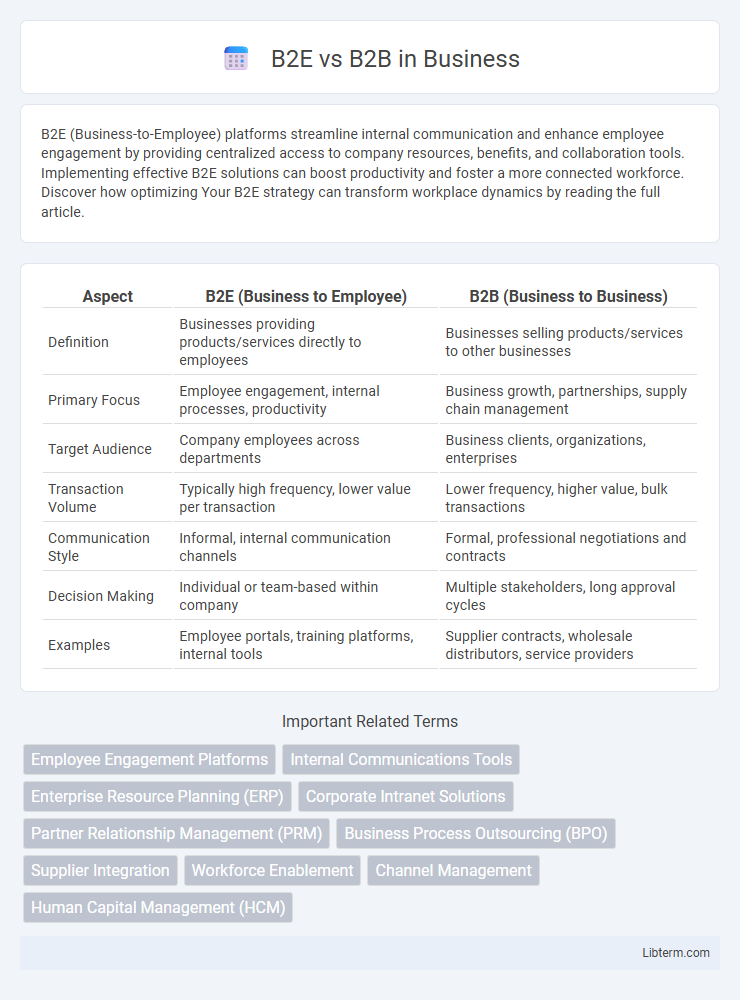
 B2E (Business-to-Employee) platforms streamline internal communication and enhance employee engagement by providing centralized access to company resources, benefits, and collaboration tools. Implementing effective B2E solutions can boost productivity and foster a more connected workforce. Discover how optimizing Your B2E strategy can transform workplace dynamics by reading the full article.
Table of Comparison
| Aspect | B2E (Business to Employee) | B2B (Business to Business) |
|---|---|---|
| Definition | Businesses providing products/services directly to employees | Businesses selling products/services to other businesses |
| Primary Focus | Employee engagement, internal processes, productivity | Business growth, partnerships, supply chain management |
| Target Audience | Company employees across departments | Business clients, organizations, enterprises |
| Transaction Volume | Typically high frequency, lower value per transaction | Lower frequency, higher value, bulk transactions |
| Communication Style | Informal, internal communication channels | Formal, professional negotiations and contracts |
| Decision Making | Individual or team-based within company | Multiple stakeholders, long approval cycles |
| Examples | Employee portals, training platforms, internal tools | Supplier contracts, wholesale distributors, service providers |
Understanding B2E and B2B: A Brief Overview
B2E (Business-to-Employee) focuses on enhancing internal employee engagement through tailored digital tools and resources, optimizing workforce productivity and satisfaction. B2B (Business-to-Business) involves transactions between companies, emphasizing long-term partnerships, bulk sales, and service agreements that drive mutual business growth. Understanding these models helps organizations design targeted strategies for internal efficiency and external market expansion.
Core Differences Between B2E and B2B Models
B2E (Business-to-Employee) models prioritize internal relationships by providing services and tools directly to a company's employees, enhancing workforce productivity and engagement. In contrast, B2B (Business-to-Business) models focus on transactions between companies, emphasizing long-term partnerships, bulk sales, and supply chain integration. The core difference lies in the target audience--B2E serves the internal workforce, while B2B targets external business clients for commercial exchanges.
Target Audiences: Employees vs Businesses
B2E (Business-to-Employee) targets internal company employees, aiming to enhance productivity, engagement, and job satisfaction through tailored services and communication. B2B (Business-to-Business) focuses on external businesses looking to purchase products or services that support operational needs or growth objectives. Understanding these distinct audiences helps companies customize marketing strategies and improve value delivery in both employee-centric and business-centric markets.
Key Benefits of B2E Solutions
B2E (Business-to-Employee) solutions enhance internal communication, streamline HR processes, and boost employee engagement by providing personalized access to company resources and self-service tools. These platforms improve workforce productivity through automation, real-time feedback, and performance management features tailored to individual employee needs. By fostering a connected and motivated workforce, B2E solutions reduce turnover rates and support talent development, which is critical for long-term organizational success.
Core Advantages of B2B Platforms
B2B platforms streamline procurement processes by enabling bulk ordering, advanced analytics, and seamless integration with enterprise resource planning (ERP) systems, leading to improved operational efficiency. These platforms foster long-term partnerships through customized pricing, contract management, and enhanced supply chain visibility. Enhanced security features and compliance controls ensure safe transactions, making B2B platforms indispensable for large-scale commercial operations.
Communication Strategies in B2E and B2B
Effective communication strategies in B2E (Business-to-Employee) prioritize internal collaboration, transparent information flow, and employee engagement through tailored messaging, intranets, and feedback systems. In contrast, B2B (Business-to-Business) communication emphasizes relationship building, trust, and value proposition clarity using targeted content, personalized outreach, and multi-channel interactions to address complex buyer needs. Both strategies leverage technology platforms but differ fundamentally in audience focus and communication objectives.
Technology Integration: B2E vs B2B
Technology integration in B2E (Business-to-Employee) focuses on deploying intranet portals, collaboration tools, and HR software to enhance employee productivity and engagement. In B2B (Business-to-Business) environments, technology integration centers on CRM systems, supply chain management, and API-driven platforms to streamline partner interactions and optimize business processes. Both models leverage cloud computing and data analytics but tailor the technology stack to meet distinct operational needs.
Challenges in Implementing B2E and B2B
Implementing B2E (Business-to-Employee) solutions faces challenges such as ensuring seamless integration with existing HR systems, maintaining user engagement, and protecting sensitive employee data. B2B (Business-to-Business) implementation often struggles with complex supply chain coordination, aligning diverse corporate cultures, and managing long sales cycles with multiple stakeholders. Both require robust data security measures and scalable platform architecture to accommodate evolving business needs.
Real-World Examples of B2E and B2B
B2E (Business-to-Employee) platforms like IBM's intranet solutions streamline internal communication and enhance employee productivity, while B2B (Business-to-Business) companies such as Salesforce provide cloud-based CRM tools that improve collaboration between different businesses. Walmart's Supplier Center is a prime example of a B2B portal that facilitates efficient inventory management and order processing across suppliers. Meanwhile, Deloitte's internal learning management systems exemplify B2E by offering tailored training programs to upskill employees within the organization.
Choosing the Right Approach: B2E or B2B for Your Business
Choosing between B2E (Business-to-Employee) and B2B (Business-to-Business) approaches depends on your company's goals and target audience. B2E strategies focus on enhancing internal communication, employee engagement, and productivity through tailored tools and platforms, while B2B strategies prioritize building robust partnerships, enhancing client relationships, and streamlining supply chains. Understanding whether your priority lies in optimizing workforce efficiency or expanding corporate clientele is crucial for selecting the most effective approach.
B2E Infographic