 libterm.com
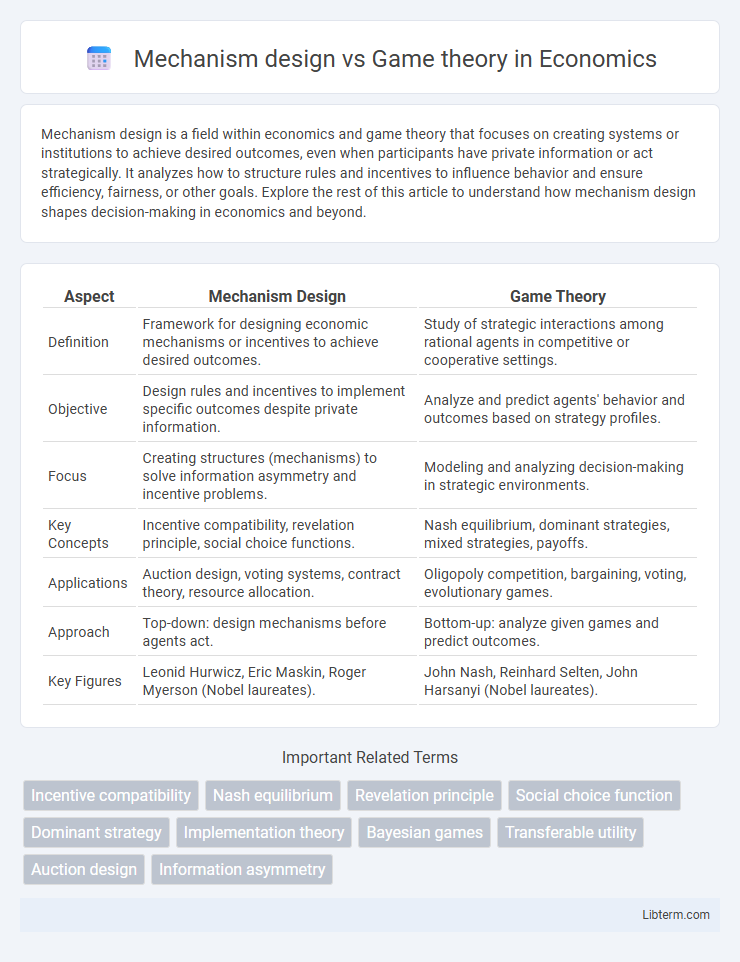
 Mechanism design is a field within economics and game theory that focuses on creating systems or institutions to achieve desired outcomes, even when participants have private information or act strategically. It analyzes how to structure rules and incentives to influence behavior and ensure efficiency, fairness, or other goals. Explore the rest of this article to understand how mechanism design shapes decision-making in economics and beyond.
Table of Comparison
| Aspect | Mechanism Design | Game Theory |
|---|---|---|
| Definition | Framework for designing economic mechanisms or incentives to achieve desired outcomes. | Study of strategic interactions among rational agents in competitive or cooperative settings. |
| Objective | Design rules and incentives to implement specific outcomes despite private information. | Analyze and predict agents' behavior and outcomes based on strategy profiles. |
| Focus | Creating structures (mechanisms) to solve information asymmetry and incentive problems. | Modeling and analyzing decision-making in strategic environments. |
| Key Concepts | Incentive compatibility, revelation principle, social choice functions. | Nash equilibrium, dominant strategies, mixed strategies, payoffs. |
| Applications | Auction design, voting systems, contract theory, resource allocation. | Oligopoly competition, bargaining, voting, evolutionary games. |
| Approach | Top-down: design mechanisms before agents act. | Bottom-up: analyze given games and predict outcomes. |
| Key Figures | Leonid Hurwicz, Eric Maskin, Roger Myerson (Nobel laureates). | John Nash, Reinhard Selten, John Harsanyi (Nobel laureates). |
Introduction to Mechanism Design and Game Theory
Mechanism design studies how to create rules or systems that lead to desired outcomes even when participants have private information and act strategically. Game theory analyzes strategic interactions where individuals' decisions affect each other's outcomes, focusing on predicting and explaining behavior in competitive situations. Both fields intersect in modeling and influencing incentives but differ in that mechanism design proactively constructs frameworks, while game theory primarily studies existing strategic scenarios.
Fundamental Concepts in Game Theory
Game theory explores strategic interactions where players' decisions impact each other's outcomes, focusing on equilibrium concepts like Nash equilibrium that predict stable strategy profiles. Mechanism design, a reverse approach, constructs rules or systems to achieve desired outcomes despite players' private information and strategic behavior. Fundamental concepts in game theory include players, strategies, payoffs, information sets, and solution concepts such as dominant strategies and subgame perfect equilibrium essential for predicting rational outcomes.
Core Principles of Mechanism Design
Mechanism design centers on creating rules and incentives to achieve specific outcomes despite participants' private information and strategic behavior. It relies on principles such as incentive compatibility, ensuring truth-telling is the best strategy, and individual rationality, guaranteeing participation benefits. Game theory provides the broader analytical framework to predict strategic interactions, while mechanism design constructs systems to align individual incentives with desired objectives.
Objectives: Predicting Behavior vs. Engineering Incentives
Mechanism design focuses on engineering incentives to achieve desired outcomes, structuring rules and payoffs to guide participants toward optimal decisions. Game theory emphasizes predicting behavior by analyzing strategic interactions among rational agents given existing rules and information. While mechanism design actively shapes environments to influence incentives, game theory primarily models and anticipates actions based on fixed settings.
Role of Information in Game Theory and Mechanism Design
Game theory studies strategic interactions among rational agents with defined information sets, analyzing how private and common knowledge influence equilibrium outcomes. Mechanism design leverages information asymmetry by structuring rules and incentives to achieve desired objectives despite incomplete or hidden information. The role of information is pivotal in mechanism design, enabling the creation of systems that induce truthful revelation and optimal allocation, in contrast to game theory's broader focus on strategy under varying informational conditions.
Equilibrium Concepts: Nash Equilibrium and Incentive Compatibility
Nash Equilibrium in game theory represents a state where no player can benefit by unilaterally changing their strategy, assuming other players' strategies remain constant. Mechanism design extends this by creating rules or systems that ensure outcomes align with desired objectives while maintaining incentive compatibility, so individual participants truthfully reveal their preferences or private information. Incentive compatibility is crucial in mechanism design to guarantee equilibrium outcomes that reflect honest behavior, contrasting with the broader strategic analysis of Nash Equilibria in game theory.
Real-world Applications: Auctions, Voting, and Markets
Mechanism design and game theory provide foundational tools for optimizing outcomes in auctions, voting systems, and market structures by designing rules that incentivize truthful behavior and efficient resource allocation. In auctions, mechanism design ensures high revenue and fairness, exemplified by the Vickrey-Clarke-Groves (VCG) auction used in spectrum sales and online advertising. Voting and market mechanisms apply game-theoretic equilibrium concepts to prevent manipulation and enhance social welfare, as seen in political elections and decentralized financial platforms.
Challenges in Implementation and Solution Robustness
Mechanism design faces challenges in implementation due to information asymmetry and incentive compatibility, making it difficult to design systems where participants truthfully reveal private information. Game theory addresses strategic interactions but often relies on assumptions like rationality and common knowledge, which may not hold in real-world scenarios, affecting solution robustness. Ensuring robustness requires combining mechanism design principles with empirical validation and adaptive algorithms to handle unpredictable behaviors and incomplete information.
Comparative Advantages and Limitations
Mechanism design specializes in creating systems or protocols ensuring desired outcomes even when participants act strategically, focusing on incentive compatibility and information asymmetry, while game theory analyzes strategic interactions among rational agents to predict equilibrium behaviors. Mechanism design excels in structured environments requiring precise outcome implementation but faces complexity and robustness issues. Game theory offers broader applicability across diverse strategic scenarios yet sometimes lacks constructive solution frameworks inherent in mechanism design.
Future Directions and Research in Mechanism Design and Game Theory
Future directions in mechanism design emphasize integrating machine learning algorithms to develop adaptive and robust mechanisms for dynamic environments. Research in game theory is increasingly focused on the analysis of multi-agent systems and the incorporation of behavioral economics to model realistic strategic interactions. Advancements in blockchain technology and decentralized finance are driving novel mechanism design frameworks that ensure transparency, incentive compatibility, and security in distributed networks.
Mechanism design Infographic